The Cheapest Quote Usually Costs the Most
When a business starts shopping for a website, price is almost always the first filter. That’s natural — budgets are real. But judging a web project on cost alone is a bit like hiring the cheapest surgeon you can find. The price is visible. What you’re paying for isn’t.
A website is not a one-time purchase. It is a living, working asset that either earns your trust with every visitor or quietly erodes it. Getting it wrong — even with a technically functional site — can cost far more than you saved on the build.
Your Website Is Your First Impression — and It Judges Fast
Studies consistently show that visitors form an opinion about a website in under a second. That opinion shapes whether they stay, explore, and eventually trust you enough to get in touch.
For most businesses, the website is the first place a prospective client lands — often before they’ve spoken to anyone at your company. A potential customer who receives your brochure, hears you at an event, or sees your name in a search result will check your website before doing anything else. What they find there either builds confidence or destroys it.
A cluttered homepage, slow load times, unclear navigation, or inconsistent visuals do not just look bad — they signal that the business behind them is disorganised, behind the times, or not serious. In competitive markets, that visitor simply moves on to the next search result. You never knew they came. You never knew they left.
What Actually Goes Into a Website
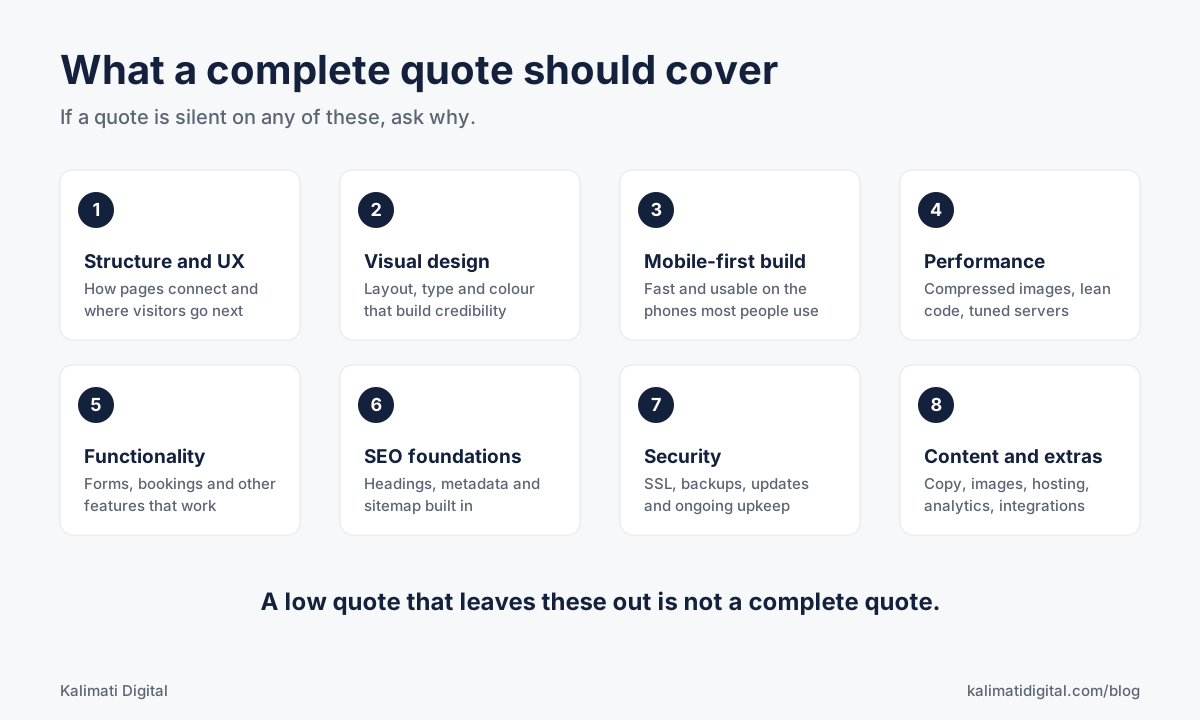
A website quote that looks low is almost always leaving something out. Here is what a serious web project actually involves:
Information architecture and UX. Before a single page is designed, someone has to decide what information goes where, how visitors move through the site, and what action each page is driving toward. Done well, this is invisible. Done poorly, visitors feel lost — and leave.
Visual design. Layout, typography, colour, spacing, and hierarchy work together to guide attention and communicate professionalism. A cheap template applied without thought will look like every other cheap template.
Responsive, mobile-first build. In India, the majority of web traffic is on mobile. A site that looks fine on a desktop but breaks or slows on a phone is, functionally, failing most of its visitors.
Performance optimisation. Page speed is not just a user experience issue — it directly affects search engine ranking. Images need to be compressed and formatted correctly, code needs to be lean, and servers need to be configured properly. This takes time and skill.
Functionality. Enquiry forms, booking systems, registration flows, ecommerce, automated emails, admin dashboards — every functional requirement adds complexity, and complexity takes time to build and test.
SEO foundations. A site that cannot be found is a site that does not exist. Basic technical SEO — proper heading structure, metadata, sitemap, page speed, mobile-friendliness — needs to be built in, not bolted on later.
Security and maintenance. Websites are attacked constantly. A site with outdated plugins, no SSL, or a weak hosting setup is a liability. Ongoing maintenance is not optional — it is the cost of keeping the asset working.
Content: The Hardest Part Nobody Prices In
Content is where most low-budget websites fall apart, and where most clients are least prepared.
Website content is not the same as your company brochure. It is not your PowerPoint deck. It is not the text you use in print ads. Each of those formats has a different purpose, a different reader, and a different way of being consumed.
A visitor to your website is scanning, not reading. They are looking for a reason to stay or a reason to leave. They need to understand, in seconds, what you do, who you do it for, and why you are the right choice. That requires audience-first writing (brochure copy talks about the company; web copy talks to the visitor), strong headlines that carry the weight of each page, specific calls to action, and a consistent tone throughout.
Good website content takes research, skill, and multiple rounds of refinement. A low-cost quote that does not include professional content writing is not a complete quote.
Imagery, Hosting, and the Invisible Infrastructure
Several line items that separate a thoughtful build from a cheap one are rarely discussed upfront.
Imagery. Stock photos that look generic undermine credibility, especially for service businesses where trust is the product. Original photography, curated licensed images, or custom illustrations cost money. They are also among the highest-return investments on a website, because people respond to authentic visuals far more than to polished clipart.
Hosting. Not all hosting is equal. Shared hosting on a cheap server in a distant country introduces latency, unreliability, and security risk. A good host offers fast servers close to your audience, automated backups, an SSL certificate, and decent support when something goes wrong. The difference in annual cost is often a few thousand rupees. The difference in performance and reliability is significant.
Domain and email. A business that uses a Gmail address from its website contact form loses credibility before the conversation begins. Professional email on your own domain is not a luxury.
Analytics and tracking. Without a properly configured analytics setup, you are flying blind. You will not know which pages are working, where visitors are dropping off, or whether any of it is converting. Setting this up correctly takes time, and cheap builds usually skip it.
Integrations. CRM connections, WhatsApp buttons, Google Maps, appointment booking, payment gateways, automated email sequences — every integration is a feature that needs to be built, tested, and maintained. A quote that omits these is a quote for an incomplete product.
The Real Cost of Getting It Wrong
A cheap website that does not perform creates costs that are harder to see on a spreadsheet but very real.
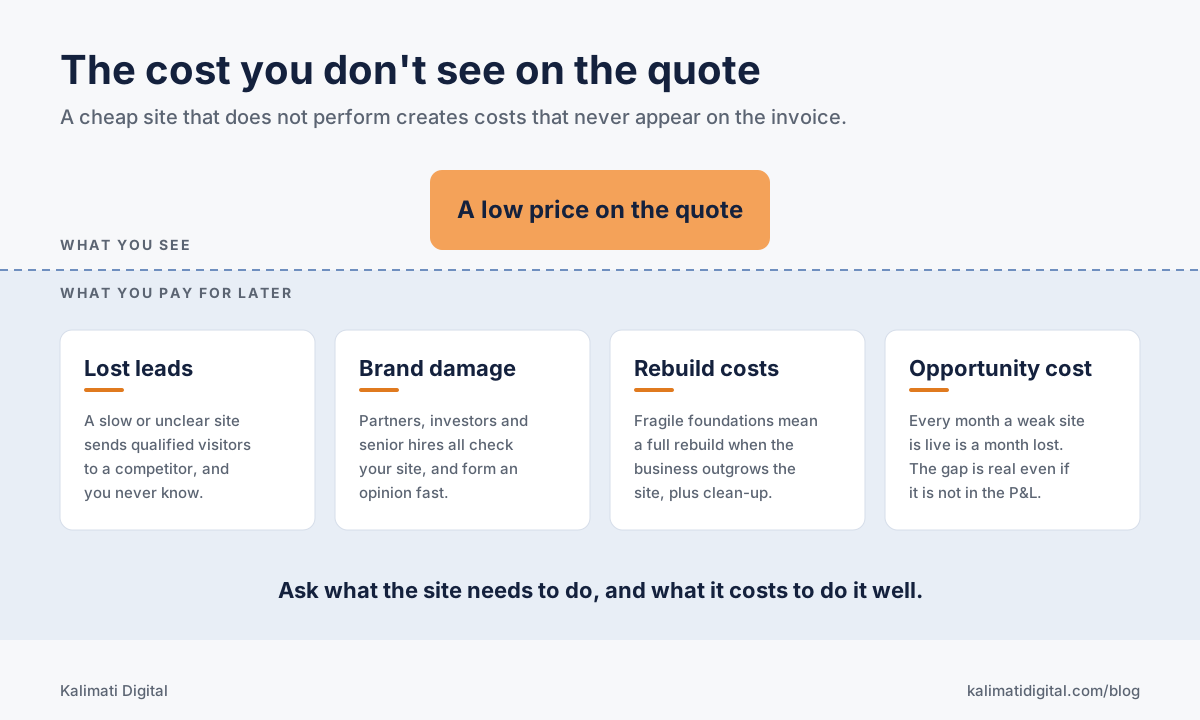
Lost leads. If your website does not clearly answer the visitor’s question and give them a confident next step, they leave. If it is slow, they leave faster. A single month of lost qualified leads often exceeds the cost of building the site properly in the first place.
Brand damage. A poor website does not just fail to convert — it actively harms your reputation. Potential partners, investors, and senior hires all check your site. What does yours say about you?
Rebuild costs. Cheap sites are often built on fragile foundations — outdated platforms, unoptimised code, templates that cannot be extended. When the business outgrows the site (and it will), a full rebuild is typically more expensive than building it right the first time, because the new agency has to clean up as well as build.
Opportunity cost. Every month a weak website is live is a month it is underperforming. The gap between what your website is doing and what it could be doing is a real number, even if it never appears in a P&L.
This does not mean the most expensive option is always the right one. It means that the right question is not “How little can we spend?” but “What does this need to do, and what will it cost to do it well?”
What to Ask Instead of “How Much?”
Before comparing quotes, ask each agency:
- What does this price include, and what does it not include?
- Who is writing the content — us or you?
- Where will the site be hosted, and why?
- What happens after launch — who handles maintenance and updates?
- Can you show me sites you have built that are similar to what we need?
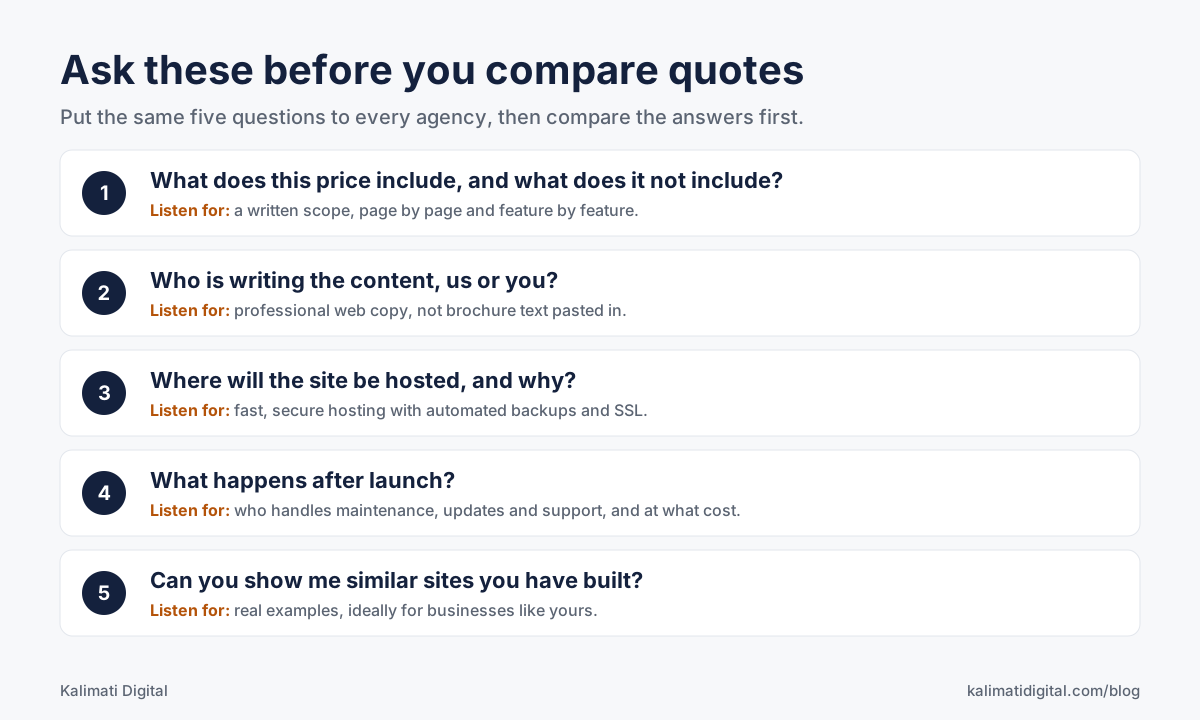
The answers will tell you more than the number at the bottom of the quote.
If you would like to see what different budgets actually buy, our guide to what a business website costs in India breaks it down by level and shows how to compare quotes line by line.
At Kalimati Digital, we build clarity-first websites designed to work — for your audience, your goals, and your budget. We will always tell you what a project needs, what it costs, and why. If you are evaluating options for your next website, we are happy to have that conversation.