Two quotes for a business website can differ tenfold and both be honest, because they are rarely quoting the same product. Business websites in India typically cost between Rs 30,000 and Rs 5 lakh or more, and the gap between those numbers is not arbitrary. It reflects how much strategy, content, design, custom functionality and ongoing support goes into the build.
If you have received quotes that range from Rs 15,000 to Rs 4 lakh for what sounds like the same project, you are not being misled. You are most likely comparing different scopes of work. This guide explains why quotes differ, what different budgets buy, and how to compare them fairly.
A website is several jobs, not one
Building an effective website takes several distinct skills. A strong site needs all of them, while a very low quote usually covers only one or two.
- Strategy and content planning. Deciding who the site is for, what visitors need to find, and how the pages should be organised and worded.
- Design. A layout, typography and visual hierarchy that make the business look credible and guide visitors to act, on every screen size.
- Development. Clean, fast, maintainable code, so the site works across browsers and can be updated without breaking.
- Search and performance. Page speed, structure and metadata that help the right people find the site.
- Testing and security. Checking forms, devices and browsers, and protecting the site against common attacks.
- Handover and support. Training, documentation and someone to call when something goes wrong.
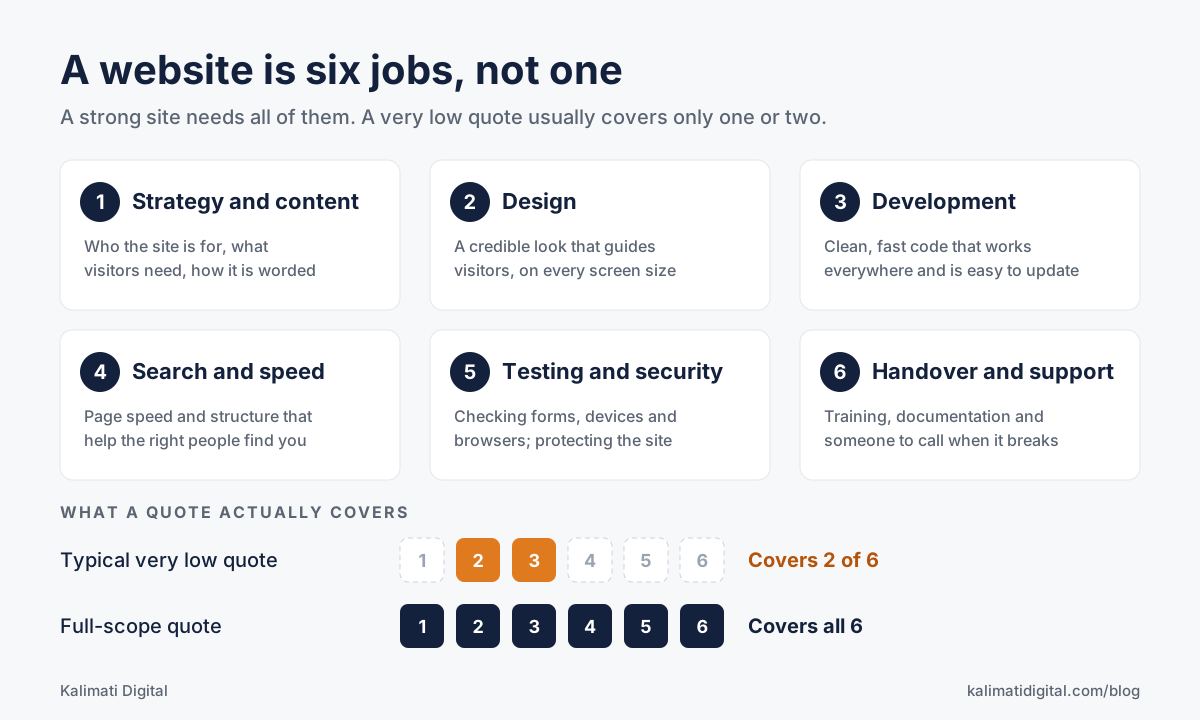
This is why two quotes for “a five-page website” can look similar and be very different. One may be a template with your logo dropped in. The other may include planning, custom design, testing and support. Our post on why the cheapest website quote isn’t the best deal looks at what going cheap typically costs.
How scope changes the price
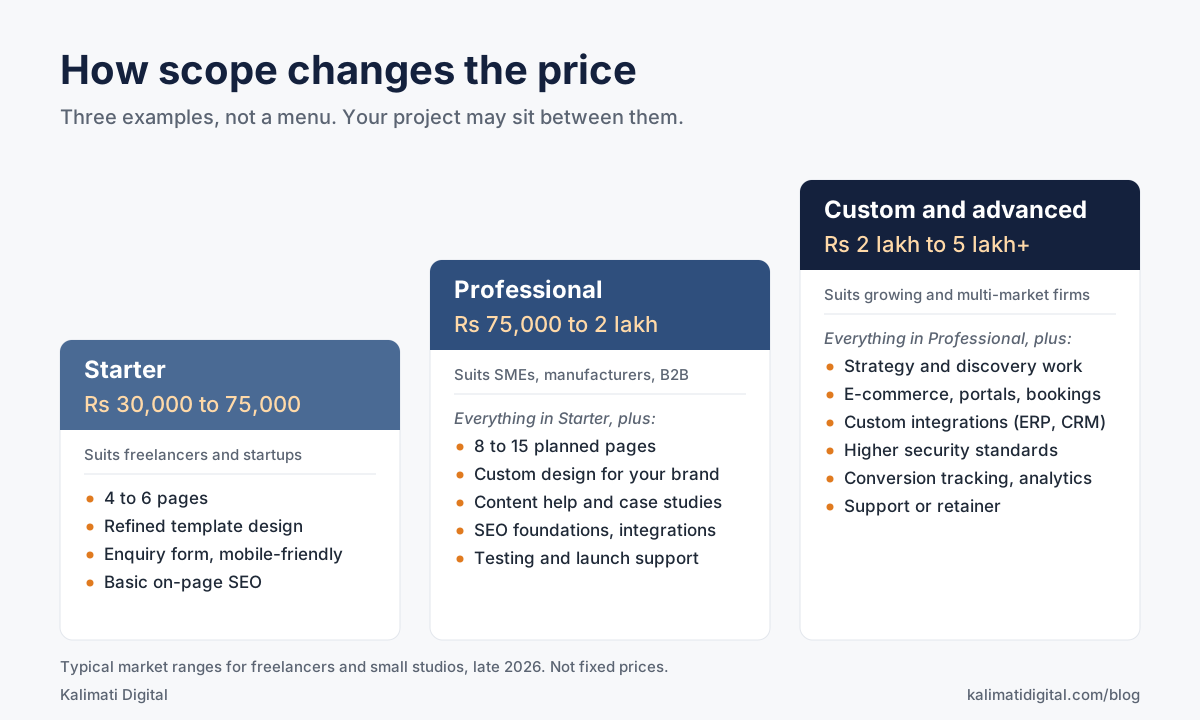
The levels below show how cost moves as scope grows. They are examples, not a menu, and your project may sit between them.
| Level | Typical price (Rs) | Best for | What you get |
|---|---|---|---|
| Starter | 30,000 to 75,000 | New businesses, consultancies, solo professionals | 4 to 6 pages, clean template-based design, enquiry form, mobile-friendly |
| Professional | 75,000 to 2 lakh | Established SMEs, manufacturers and industrial units, B2B firms | 8 to 15 pages, custom design, content structure, SEO foundations, integrations |
| Custom and advanced | 2 lakh to 5 lakh+ | Growing companies, e-commerce, portals, multi-market brands | Custom design and development, complex features, strategy, ongoing support |
These are typical market ranges for freelancers and small studios as of late 2026, not fixed prices. Rates vary with the designer’s experience, the city, and how much of the content and strategy work you need help with.
What actually drives the price
Website pricing comes down to how much thinking and building the project needs, not just how many pages it has. Five factors move the number most:
- Scope. A five-page brochure site and a fifteen-page site with service sections, case studies and a blog are very different amounts of work.
- Design approach. Adapting a quality template is faster and cheaper than designing every page from a blank canvas around your brand and your visitors.
- Content. If you supply finished text and images, the cost is lower. If the designer has to plan the structure, write copy or source photography, that effort is part of the price.
- Functionality. A contact form is simple. Online payments, user logins, booking systems, multi-language support or integrations with your CRM add real development time.
- Who does the work. A freelancer, a small studio and a large agency all have different overheads, processes and levels of accountability, and their prices reflect that.
The question to ask any designer is not “how much for a website?” but “what exactly does this price include?”
Starter: Rs 30,000 to Rs 75,000
A starter website gives a new or small business a credible, professional online presence without a large upfront investment. For many consultancies, solo practitioners and early-stage firms, this level is all they need to begin.
What you typically get
- 4 to 6 pages: Home, About, Services, Contact, and perhaps one or two more
- A refined template or lightly customised design that matches your logo and colours
- Mobile-friendly layout that works on phones and tablets
- A working enquiry form and basic contact details
- Basic on-page SEO, such as page titles and descriptions
- Setup of domain and hosting, with a short handover
What it usually does not include
- Original copywriting or photography
- Custom illustrations or bespoke layouts
- Advanced integrations, payments or user accounts
- Ongoing content updates or marketing
Who it suits. Freelancers, independent professionals, local service businesses and startups that need a trustworthy page to share with clients. You can launch lean now and add pages and features as the business grows.
Professional: Rs 75,000 to Rs 2 lakh
At this level the website stops being a digital brochure and starts working as a business tool. The extra investment pays for planning, a design built around your brand and your visitors, and a structure that helps people find what they need quickly.
What you typically get
- 8 to 15 pages, with a planned site structure and clear navigation
- A custom design created for your brand, not adapted from a stock template
- Help organising and sharpening your content, and sometimes copywriting
- Service pages, case studies or a portfolio, and often a blog
- SEO foundations: page speed, structure, metadata and search-friendly URLs
- Integrations such as analytics, WhatsApp chat, email tools or a CRM
- Testing across devices and browsers, plus a short period of post-launch support
Who it suits. Established SMEs, B2B companies, professional firms and manufacturers who rely on their website to build trust and generate leads. If a prospect should be able to understand what you do within seconds, this is usually the right level.
This is also where a clarity-first approach pays off most, because the value comes from deciding what to say and how to present it, not only from the build itself.
Custom and advanced: Rs 2 lakh to Rs 5 lakh and above
This level is for businesses whose website is central to how they sell, serve customers or operate. The cost rises because the work moves from presenting information to building systems.
What you typically get
- Strategy and discovery workshops before any design begins
- Fully custom design and front-end development
- Complex functionality: e-commerce, payment gateways, customer portals, booking or quoting tools, multi-language or multi-region sites
- Custom integrations with ERP, CRM, inventory or other business software
- Performance, security and accessibility work to a higher standard
- Structured content migration, analytics setup and conversion tracking
- A support or retainer arrangement after launch
Who it suits. Growing companies, online stores, businesses selling across India and overseas, and organisations with specific workflows that off-the-shelf tools cannot handle.
Prices above Rs 5 lakh are common for large e-commerce builds, portals and projects with extensive custom development. Scope here is best fixed through a detailed proposal rather than a quick quote.
What small and medium industries need
Small and medium manufacturers, fabricators, component makers and industrial suppliers have different needs from a typical service business. Their buyers are often procurement managers and engineers who check a supplier online before sending an enquiry, so the website has to answer practical questions quickly.
A good industrial website usually covers:
- Products and capabilities. Clear product or process pages with specifications, materials, tolerances and applications, rather than a vague list of services.
- Plant and infrastructure. Photographs of the facility, machinery and quality-control setup, which build confidence faster than descriptions do.
- Certifications and standards. ISO and other certifications, test facilities and compliance information, displayed where buyers can find them.
- Clients and proof of work. Industries served, sample projects or references, with permission where needed.
- An easy enquiry route. A request-for-quote form that accepts drawings or specifications, plus a visible phone number and WhatsApp link.
- Being found locally. A Google Business Profile and local search presence, so buyers searching for suppliers in your industrial area can find you.
A marketplace listing can bring in enquiries, but it does not replace a website you own. Your own site is where you control how your company is presented, and it is the first place a serious buyer verifies you.
Most small and medium industries are well served by the Starter level at the upper end of its range, or the lower end of Professional, typically Rs 50,000 to Rs 1.5 lakh. A catalogue of many products, multiple plants or an export-focused site with several languages moves the project toward the higher levels.
Costs people forget
The build price is not the whole budget. Ask every designer whether the following are included, and plan for them either way. The figures below are approximate yearly ranges and vary by provider.
| Item | Approximate cost (Rs per year) | Notes |
|---|---|---|
| Domain name | 500 to 1,500 | A .in or .com address; renews every year |
| Web hosting | 3,000 to 20,000 | Depends on traffic, speed and the quality of the host |
| Business email | 1,500 to 6,000 per user | Optional, but looks more professional than a free email address |
| Maintenance and updates | 10,000 to 60,000 | Security patches, backups, small content changes |
| Content and photography | One-time, project dependent | Copywriting, professional photos or video |
| GST | 18% on services | Applies to most web design invoices if the provider is registered |
Two points deserve attention. First, a website you cannot update or secure is a liability, so ongoing maintenance is worth budgeting even when it is modest. Second, a cheap build with expensive hidden add-ons often ends up costing more than a clearly scoped higher quote.
How to choose the right level
Start with what the website must do for your business, then match the budget to it. Before approaching a designer, decide:
- The goal. Do you need credibility, enquiries, online sales or something else?
- The audience. Who will visit, and what do they need to find in the first few seconds?
- The content. What do you already have: text, logo, photos, case studies?
- The budget. Give an honest range. A good designer will tell you what that range can and cannot achieve.
Then ask each designer you speak to:
- What exactly is included in this price, page by page and feature by feature?
- Who writes the content, and who owns the design files and the site after launch?
- What are the hosting, domain and maintenance costs after year one?
- How many rounds of revisions are included?
- Can I see similar work, and speak to a past client?
- What happens if I want to add pages or features later?
A clear, specific answer to these questions is a better sign of quality than a low price.
How to compare two quotes
Two quotes are only comparable when they describe the same work. Ask each designer to put the following in writing, then compare them line by line.
| Check | What to look for |
|---|---|
| Pages and content | Number of pages, and who writes the text and sources the images |
| Design | Custom design or an adapted template |
| Revisions | How many rounds are included |
| Ownership | Who owns the design, code, domain and hosting account |
| After launch | Support period, maintenance and update costs |
| Exclusions | What is not included, and what extras cost |
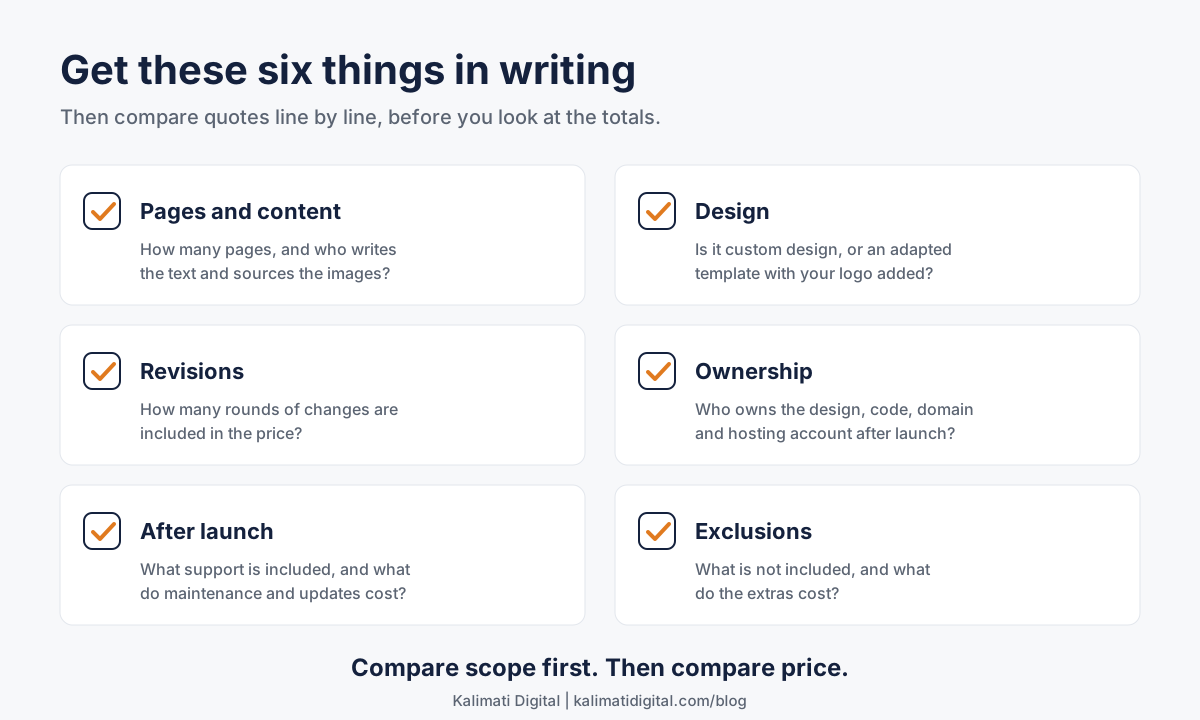
If a quote cannot answer these, the low price is probably hiding the gap. Put the answers side by side before you look at the totals.
Related reading: Why the Cheapest Website Quote Isn’t the Best Deal covers what going cheap typically costs you, and works as a companion to this guide.
Where to start
There is no single correct price for a business website, only the right price for the job you need it to do. A focused starter site can serve a new business well, a professional build suits companies that depend on their website to win work, and advanced projects justify a larger investment because they do more. Whatever you decide, ask every designer for a written scope before you compare prices, because a quote you cannot compare line by line is not one you can trust.
If you are unsure which level fits, tell us what your business does and what you want visitors to do on your site. We will recommend a scope that suits your budget, and we will be clear about what is and is not included.
Get in touch with Kalimati Digital for a no-obligation conversation.